

One thousand. That is the light gap between a 99 percent eclipse and a 100 percent eclipse. At 99 percent the open sliver of photosphere still pours about 1,000 lux over you, the light of an overcast noon. Your pupils adapt and nothing feels wrong. At 100 percent the light drops to the level of a full moon. The corona unfolds, Venus switches on, and the horizon runs a 360 degree sunset. On Wednesday 12 August 2026 the total solar eclipse runs that experiment over nine countries in one evening.
Totality is not rare. Somewhere on Earth the moon covers the sun completely about every eighteen months. Rare means the shadow visits you. Peninsular Spain last stood under it in 1905. Iceland last did in 1954, and waits until 2196 for the next one.
Totality opens at midnight over Siberia with the sun scraping the horizon. It clips northeast Greenland, crosses western Iceland, and dies at dusk over the Balearics. Russia, Greenland, Iceland and Spain stand under it. Portugal, France, Denmark, the United Kingdom and Ireland get a deep partial. Every country reads its own map, so this paper covers the whole shadow. A 99 percent eclipse is a 100 percent miss.
The moon fits the sun by accident
The sun is 400 times wider than the moon. It also sits 400 times farther away. Both disks span half a degree of sky, and one slides over the other like a coin over a coin.
The fit is tight, so the umbra barely reaches the ground. On 12 August it lands as an oval at most 294 kilometers wide. Astronomers call the strip it sweeps the path of totality. This paper calls it the band. Inside the oval, night in the middle of the day. One step outside, daylight with a dimmer. The gradient you expect does not exist. The eclipse is binary.
Timing shapes this edition. The umbra reaches Iberia at the end of the day, and a low sun drags the oval long across the map. Totality finds the sun 12 degrees high in A Coruña and 1.5 degrees high in Menorca. Those two numbers decide where you stand.
A 99 percent eclipse is still daylight
The photosphere is absurdly bright. Cover 99 percent of it and the sliver still owns the sky.
- Clear noon: about 100,000 lux.
- 99 percent covered: about 1,000 lux. A dark overcast day. Streetlights stay off.
- Totality: moonlight. The full sun is 400,000 times brighter than the full moon.
The corona burns around the sun every day of the year, about as bright as the full moon. Daylight scatter buries it, and one percent of photosphere is still daylight. Only totality kills the glare. The last percent is a light switch.
At 99 percent you wear glasses for two hours and watch a bite leave an orange cookie. At 100 percent you drop the glasses and stand in a hole punched through the day. Two different events, half an hour of driving apart.
Drag the moon across the sun and watch the light meter, not the discs. The scale is logarithmic because your pupils are. In a total eclipse the moon disc is the larger one, in an annular it is the smaller one, and in a partial the alignment misses. The last percent is a light switch.
Cones rule: red and green both read as themselves.
A bite leaves the cookie. Without glasses nobody would notice.
The ground strip shows the colander effect: every gap projects the uncovered shape of the sun, so tree shade fills with crescents. Disc ratios are the real ones: 1.045 for 12 August 2026, 0.955 for the annular of 26 January 2028.
Then there is the 99.97 club. Madrid, Santiago de Compostela and Pamplona all finish at 99.97 percent covered. Three hundredths of one percent, three cities, zero corona. Barcelona misses by 0.16. The band threads between the two biggest cities in the country, which is either bad luck or a sense of humour. Ninety minutes of driving fixes it. From Madrid take Soria, which pays 1 minute 43, or Segovia, which pays 59 seconds on the band edge. From Barcelona take Tarragona. From Porto, A Coruña is under three hours. From Toulouse or Bordeaux, aim at Zaragoza or Bilbao. Book nothing fancy. Stand in a field.
The saros repeats this eclipse every 18 years
Three lunar clocks have to agree for an eclipse to repeat. Phase, node crossing, and distance. NASA puts the agreement at 6,585.32 days: 223 lunar months, 242 node returns, 239 distance returns, all landing within hours of each other. That interval is one saros. In plain units, 18 years, 11 days and 8 hours.
The 8 hours carry the payoff. Earth keeps turning through them, so the next eclipse of a series lands about a third of the way around the planet, westward. Watch it happen in one series. On 1 August 2008 the greatest eclipse fell at 65.7 north, 72.3 east, near Nadym in Siberia. On 12 August 2026 it falls at 65.2 north, 25.2 west, off Iceland. Same latitude to within half a degree. Ninety seven degrees of longitude west.
This eclipse is number 48 of 72 in Saros 126. The series was born on 10 March 1179 and dies on 3 May 2459. Number 41 fell on 28 May 1900 and crossed Spain, which is why El Orden Mundial calls Wednesday a replica. Spain did not get lucky twice. Spain got the same eclipse back.
Run the series and watch it happen. The globe below plays all 72 members on NASA's own Besselian elements. Tap a country and the camera holds there. The shadows keep marching past. Scrub the strip for any member.
- gamma
- 0.8977
- mag
- 1.0386
- width
- 294 km
- dur
- 02m18s
- 1179 Mar 10, partial
- 1197 Mar 20, partial
- 1215 Mar 31, partial
- 1233 Apr 11, partial
- 1251 Apr 22, partial
- 1269 May 02, partial
- 1287 May 14, partial
- 1305 May 24, partial
- 1323 Jun 04, annular
- 1341 Jun 14, annular
- 1359 Jun 26, annular
- 1377 Jul 06, annular
- 1395 Jul 17, annular
- 1413 Jul 27, annular
- 1431 Aug 08, annular
- 1449 Aug 18, annular
- 1467 Aug 29, annular
- 1485 Sep 09, annular
- 1503 Sep 20, annular
- 1521 Sep 30, annular
- 1539 Oct 12, annular
- 1557 Oct 22, annular
- 1575 Nov 02, annular
- 1593 Nov 22, annular
- 1611 Dec 04, annular
- 1629 Dec 14, annular
- 1647 Dec 26, annular
- 1666 Jan 05, annular
- 1684 Jan 16, annular
- 1702 Jan 28, annular
- 1720 Feb 08, annular
- 1738 Feb 18, annular
- 1756 Mar 01, annular
- 1774 Mar 12, annular
- 1792 Mar 22, annular
- 1810 Apr 04, annular
- 1828 Apr 14, hybrid
- 1846 Apr 25, hybrid
- 1864 May 06, hybrid
- 1882 May 17, total
- 1900 May 28, total
- 1918 Jun 08, total
- 1936 Jun 19, total
- 1954 Jun 30, total
- 1972 Jul 10, total
- 1990 Jul 22, total
- 2008 Aug 01, total
- 2026 Aug 12, total
- 2044 Aug 23, total
- 2062 Sep 03, partial
- 2080 Sep 13, partial
- 2098 Sep 25, partial
- 2116 Oct 06, partial
- 2134 Oct 17, partial
- 2152 Oct 28, partial
- 2170 Nov 08, partial
- 2188 Nov 18, partial
- 2206 Dec 01, partial
- 2224 Dec 11, partial
- 2242 Dec 22, partial
- 2261 Jan 02, partial
- 2279 Jan 13, partial
- 2297 Jan 23, partial
- 2315 Feb 05, partial
- 2333 Feb 15, partial
- 2351 Feb 27, partial
- 2369 Mar 09, partial
- 2387 Mar 20, partial
- 2405 Mar 31, partial
- 2423 Apr 11, partial
- 2441 Apr 21, partial
- 2459 May 03, partial
Three neighbours tell the story on their own. Member 41 crossed Spain in 1900. Member 47 crossed Siberia in 2008. Member 48 arrives on Wednesday, one third of the planet west of Siberia, at the same latitude.
One shadow, nine countries
Russia opens the show at midnight, east of the Taymyr peninsula. The sun sits on the horizon line there, half in and half out, and the umbra catches it anyway. Cape Pronchishchev gets 1 minute 36 seconds. Almost nobody lives there, so the reindeer get the premiere.
The umbra then vaults the Arctic and clips northeast Greenland at 17:18 UTC. Station Nord, a Danish outpost, gets 20 seconds. That is the Kingdom of Denmark's entire slice of totality: a trailer, not a film. Copenhagen itself keeps 84 percent.
Iceland is the first stop with roads, beds and a full minute. The western half of the island sits inside the band, and the sun rides 25 degrees up. Reykjavík gets 1 minute 03 at 17:48 local. Keflavík airport, 50 kilometers down the road, gets 1 minute 41, so the arrivals hall beats the capital. The Látrabjarg cliffs at the western tip get 2 minutes 14, the longest totality on land anywhere on the band. The absolute maximum runs 2 minutes 18 seconds, 45 kilometers offshore. The best seat in the house is wet.
Spain gets the finale at dinner time. The umbra makes landfall at Estaca de Bares in Galicia at 20:26:37 and leaves Formentera at 20:33:58. Seven minutes and twenty one seconds for the whole country. It enters through the north coast of Galicia and Lugo. It sweeps the Cantabrian strip through Oviedo, Santander, Bilbao and Vitoria. It runs the Duero and the Ebro through León, Burgos, Valladolid, Logroño, Soria and Zaragoza. It exits by Teruel, Castelló, València, Tarragona and the Balearics. Everywhere the sun hangs low, because this is a sunset eclipse.
Ten places on the band, on the local clock. Times are the start of totality.
| Place | Totality starts | Totality lasts |
|---|---|---|
| Cape Pronchishchev, Russia | 23:59 | 1m 36s |
| Station Nord, Greenland | 17:18 | 0m 20s |
| Látrabjarg, Iceland | 17:44 | 2m 14s |
| Keflavík, Iceland | 17:48 | 1m 41s |
| Reykjavík, Iceland | 17:48 | 1m 03s |
| Oviedo, Spain | 20:27 | 1m 50s |
| Burgos, Spain | 20:28 | 1m 45s |
| Zaragoza, Spain | 20:29 | 1m 26s |
| Palma, Spain | 20:31 | 1m 37s |
| València, Spain | 20:32 | 1m 02s |
Outside the band the partial runs deep. About 98 percent in Porto, 94 in Lisbon and Dublin, 92 in Paris, 91 in London, 84 in Copenhagen, 83 in Oslo. Deep enough to notice. Not enough to count.
Where to stand
Ninety minutes of driving for two minutes of sky. The trade sounds absurd. Then you price it. One thousand lux against moonlight. A partial eclipse against the corona. Drive.
- Get deep into the band. Totality at the edge lasts seconds. The center line pays in full.
- In Spain, audit the west-northwest horizon first. A 10 meter building 200 meters away blocks 3 degrees of sky. On the Mediterranean side that is the entire show. Find a shoreline, a ridge or a rooftop.
- In Iceland the sun rides well clear of the horizon, so clouds decide everything. Keep a car and three escape roads.
- Check the forecast at breakfast, commit by noon, and accept a 100 kilometer drive. A fixed plan is how people end up under the only cumulus in the province.
Two rules for your eyes
The two rules are the two eclipses. Rule one governs the 99 percent world. Rule two exists only inside the last percent.
Rule one: if any photosphere shows, filter. Sunglasses fail. Smoked glass fails. Stacked film fails. Certified ISO 12312-2 glasses pass, and shade 14 welding glass passes. Cameras, binoculars and telescopes need filters on the front, because a filter behind the optics arrives too late. No filter at hand? A kitchen colander projects a dozen crescent suns on the ground for free. Portugal, France, the United Kingdom, Ireland and Denmark run rule one from first bite to last. There the glasses never come off.
Rule two: during totality, look. The glasses that protected you now show pure black. The corona is moonlight, and moonlight is safe. During totality, and only during totality, watch with naked eyes. Drop the glasses when the diamond ring collapses. Put them back at the first flash on the far edge.
What the light does in the last hour
The hour before totality is already the event.
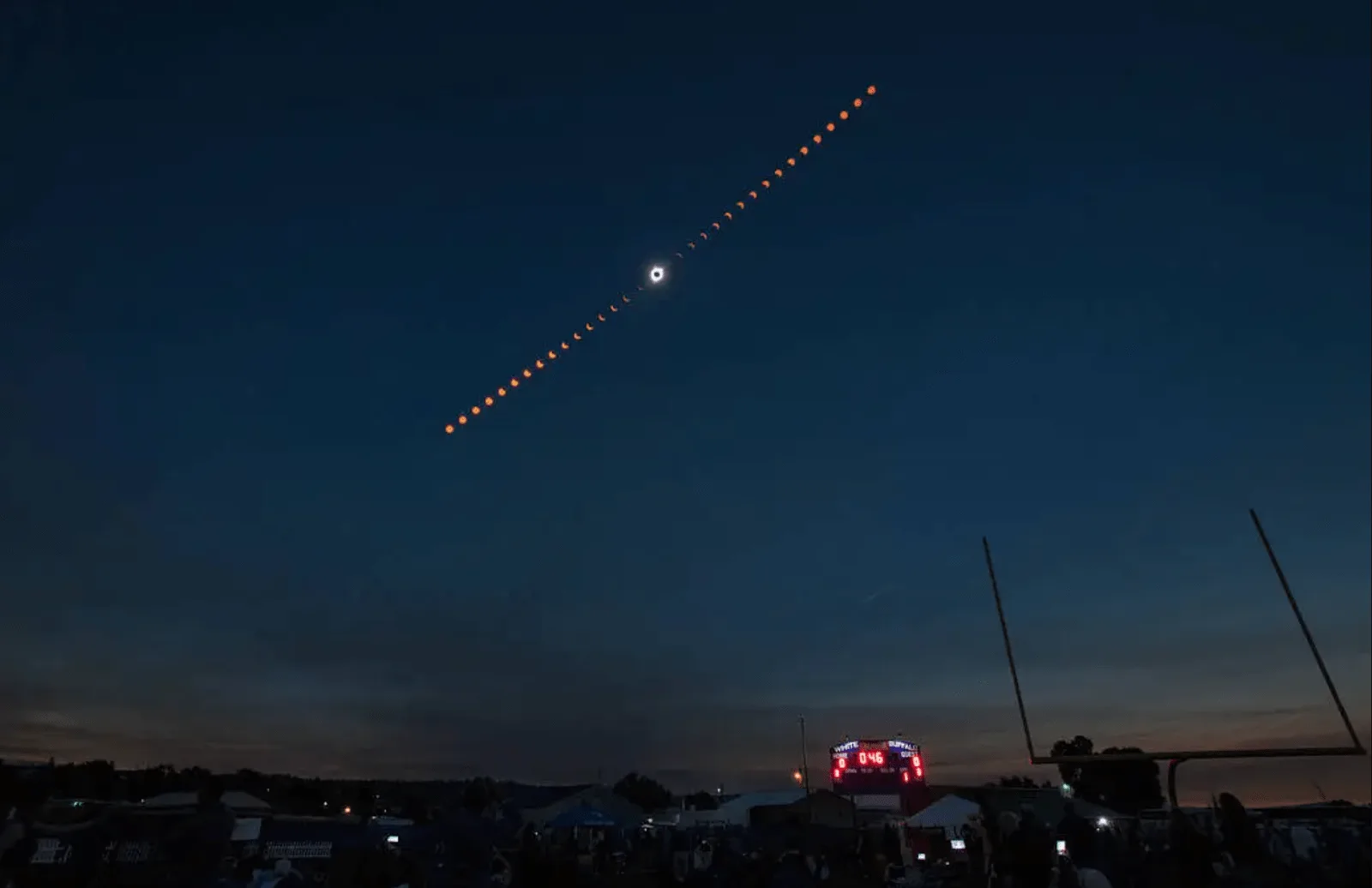 VISUAL // ARCHIVEProgression of the August 2017 total eclipse over Oregon, United States | Aubrey Gemignani (NASA)1600×1036px
Thirty minutes out the sun narrows to a slit, so shadows sharpen to knife edges and the light goes faintly green, then metallic. Cameras will not capture it. Around twenty minutes out the Purkinje shift arrives. Rod vision peaks near 507 nanometers and cone vision near 555, so as the light dies your eyes hand over to the rods. Red collapses to gray. Green holds and turns luminous. RTVE turned that into a national dress code: wear red next to green and watch one of them quit.
Ten minutes out the temperature slides 2 or 3 degrees and the breeze turns. Birds fly home. At the 2015 Faroe Islands eclipse, every dog in town howled at once.
In the last minute, shadow bands ripple over white ground for 20 or 30 seconds, so bring a white sheet. Then face west-northwest and watch the umbra arrive as a wall of dusk. Baily's beads fire as sunlight threads the last lunar valleys. The final bead is the diamond ring.
Then the corona, white and structured, with pink prominences pinned to the rim. Venus first, then the brighter stars. Sunset orange on every horizon at once. People gasp and clap and cry, and the sound is part of the show. Your first eclipse deserves eyes. Instagram gets the second one.
Load this page before you leave: the band will have no signal, and everything here runs offline. The companion tracks the clock at your spot and tells you the one thing that matters in each phase, including the only two minutes when the glasses come off.
first contact in
17 h 36 m 47 s
This spot tops out at 100% covered, glasses on throughout. First contact at 19:36:47 CEST. Glasses ready: nothing before totality is safe without them.
- The bite
- The deep partial
- Past maximum
- The waning partial
Clocks in CEST. Drag the slider to preview the evening; live mode follows your clock. Times come from the same geometry as every figure above, for Madrid.
If the clouds win
Clouds delete the corona and keep the collapse. Under full overcast, totality still snaps day to night in seconds, the temperature still falls, the birds still panic. Stand in the band anyway.
Spain also holds a rematch. On 2 August 2027 a total eclipse crosses Cádiz, Málaga, Ceuta and Melilla, longer and higher in the sky. On 26 January 2028 an annular one runs southwest to northeast across the peninsula, Madrid included. Spain went 121 years with nothing, then booked three solar eclipses in eighteen months. Iceland has no rematch until 2196, so chase the gaps there.
That night the Perseids peak, and an eclipse guarantees a new moon. The sky is dark by construction. Stay out.
Spain waited 121 years for this evening. Iceland waited 72. A 99 percent eclipse is a 100 percent miss. Get inside the band.